What is a C&I lithium battery? A Deep Dive into Commercial Energy Storage ROI and Safety Trends
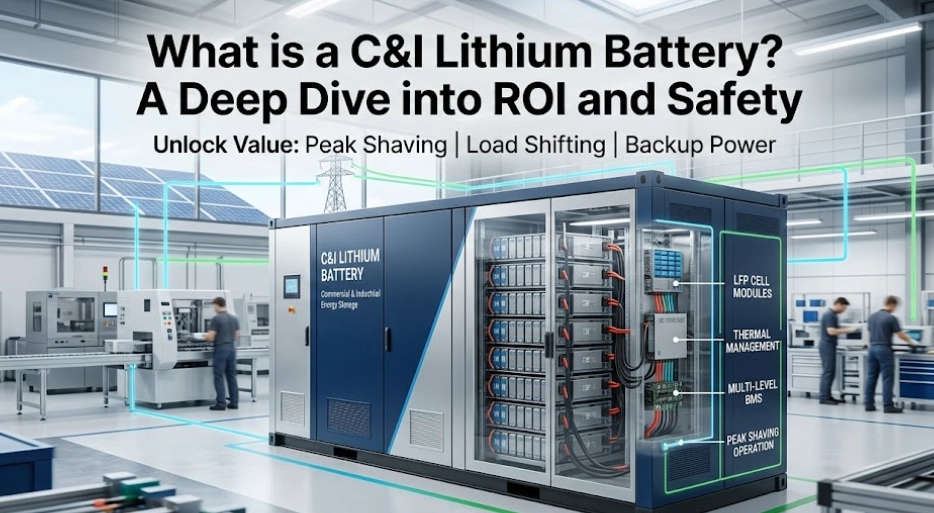
A C&I lithium battery (commercial and industrial lithium battery) is a high-capacity electrochemical energy storage solution engineered specifically for enterprises, manufacturing facilities, data centers, and localized microgrids to optimize power consumption, manage peak demand, and ensure operational resilience. These systems consolidate lithium-ion cells, smart thermal management, and localized control software into a unified asset capable of handling heavy, fluctuating industrial electrical loads. The Core Science: How Commercial Lithium Batteries Store Power At the molecular level, these large-scale storage systems operate via the reversible intercalation of lithium ions. During the charging cycle, external electrical energy drives lithium ions out of the cathode matrix—typically composed of highly stable lithium iron phosphate (LiFePO₄)—moving them through a specialized liquid electrolyte and across a polymer separator into the graphite anode. During discharge, the process reverses spontaneously. The lithium ions migrate back to the cathode, releasing free electrons that travel through the external commercial circuit to power machinery and facility infrastructure. The choice of olivine crystal structures in industrial-grade cells ensures that even during rapid charge-discharge cycles, the internal chemical framework resists structural degradation and oxygen release, significantly mitigating thermal runaway risks. Unlocking Value: The Core Advantages of Modern B2B Energy Storage Implementing a robust commercial and industrial energy storage system yields profound financial and operational returns. Empirical testing data indicates that premium industrial-grade battery cells sustain a round-trip efficiency (RTE) exceeding 92%, maintaining over 80% of their original capacity even after 6,000 consecutive full charge-discharge cycles at 1C operational rates. From a financial perspective, the primary driver is automated peak shaving and load shifting. By charging the battery array during off-peak hours when utility tariffs are low and discharging during peak-demand periods, facilities bypass exorbitant demand charges. Field deployments show that high-energy-demand manufacturing plants routinely achieve a 15% to 30% reduction in monthly electricity expenditures while gaining an instantaneous backup power source that prevents costly production line downtime. Precision Engineering: From Cell Assembly to Microgrid Deployment The journey of a reliable LFP battery pack from raw material to a commercial enclosure involves highly automated, precise manufacturing protocols. During production line assembly, cells undergo automated laser and ultrasonic welding to form modules, with strict quality controls keeping contact resistance below 0.2 $m\Omega$ to prevent localized hot spots. [Raw Cells] ➔ [Ultrasonic Welding (<0.2 mΩ)] ➔ [Module Testing] ➔ [Liquid Cooling Integration] ➔ [IP55 Enclosure Deployment] These modules are integrated into heavy-duty IP55 or IP66-rated enclosures equipped with advanced multi-level battery management systems (BMS) and liquid-cooling thermal management. These complete systems are deployed across diverse applications, including powering critical infrastructure in remote mining operations, stabilizing voltage in EV charging stations, and buffering green energy generated by commercial solar arrays. Head-to-Head: C&I Lithium Battery vs. Traditional Lead-Acid Systems Performance Metric C&I Lithium Battery (LFP) Traditional Lead-Acid (AGM/Gel) Cycle Life (80% DoD) 6,000 – 8,000 cycles 500 – 1,500 cycles Usable Depth of Discharge (DoD) Up to 90% – 100% 50% max (to prevent damage) Round-Trip Efficiency (RTE) 92% – 95% 75% – 80% Physical Footprint / Weight Ultra-compact; high energy density Bulky; requires significant floor reinforcement Maintenance Requirements Zero active maintenance; remote BMS Regular venting, watering, and physical inspection Frequently Asked Questions (FAQ) What is the typical payback period for a C&I lithium battery system? Depending on regional utility tariff structures, demand charge penalties, and local subsidies, most commercial facilities realize full ROI within 4 to 7 years, while the asset continues to deliver value for over 15 years. How do liquid cooling systems improve safety in industrial batteries? Liquid cooling circulates specialized coolant directly through thermal plates sandwiched between battery modules. This keeps internal cell temperatures within an optimal window (20°C to 35°C), eliminating thermal imbalances and preventing cascading thermal runaway events. Can these systems integrate directly with existing commercial solar arrays? Yes. Modern systems utilize hybrid power conversion systems (PCS) that integrate seamlessly with existing commercial photovoltaic (PV) setups, allowing businesses to store excess solar energy and maximize self-consumption.
Contact Us
Have questions about our products or solutions? Get in touch with our team.